Operational and Efficiency Gains in Controlled Environment Agriculture
This analysis, produced by Entrepreneurial Solutions in association with the University of Colorado Boulder Leeds School of Business, quantified the efficiency and operational gains possible through automated hybrid sunlight strategies, improved controls precision, and better data capture in controlled environment agriculture.
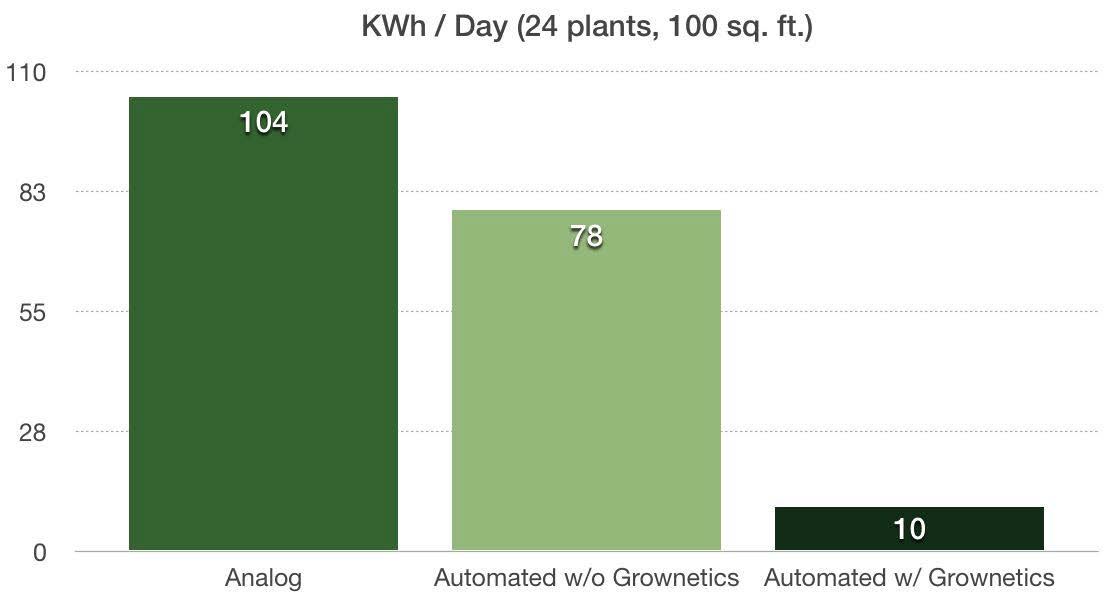
Key findings
- • Automated hybrid sunlight strategies achieved 40%+ efficiency gains compared to sole-source LED approaches
- • Lighting energy costs dropped 87% to 90% in a modeled 100 sq ft, 24-plant environment
- • Water savings ranged from 42% to 94%, with recapture and reuse up to 82% in a typical hydroponic system
- • Labor savings improved margins while reducing manual logging and aggregation work
Why it matters
The value is not just lower utility costs. Better controls precision, better data logging, and tighter operational feedback loops compound over time. That means more stable production, less wasted labor, and better decision-making across the whole facility.
These gains were demonstrated through a combination of hybrid sunlight strategies (solar tubes + supplemental LED), intelligent HVAC load reduction, and automated environmental monitoring that replaced manual data workflows.
Source context
The original analysis compared Grownetics-enabled automation against analog and traditional automated systems, with emphasis on lighting energy, water use, labor efficiency, and data logging burden in controlled environment agriculture.
Want to quantify what efficiency gains could look like in your facility?
We can scope monitoring, controls, and deployment pathways based on your operation and utility profile.