Why Resolution Is the Ceiling on Yield
CropVision gives operators the resolution to see what averages hide. A wall thermostat is one pixel in the wrong place, and that blind spot becomes the ceiling on yield.
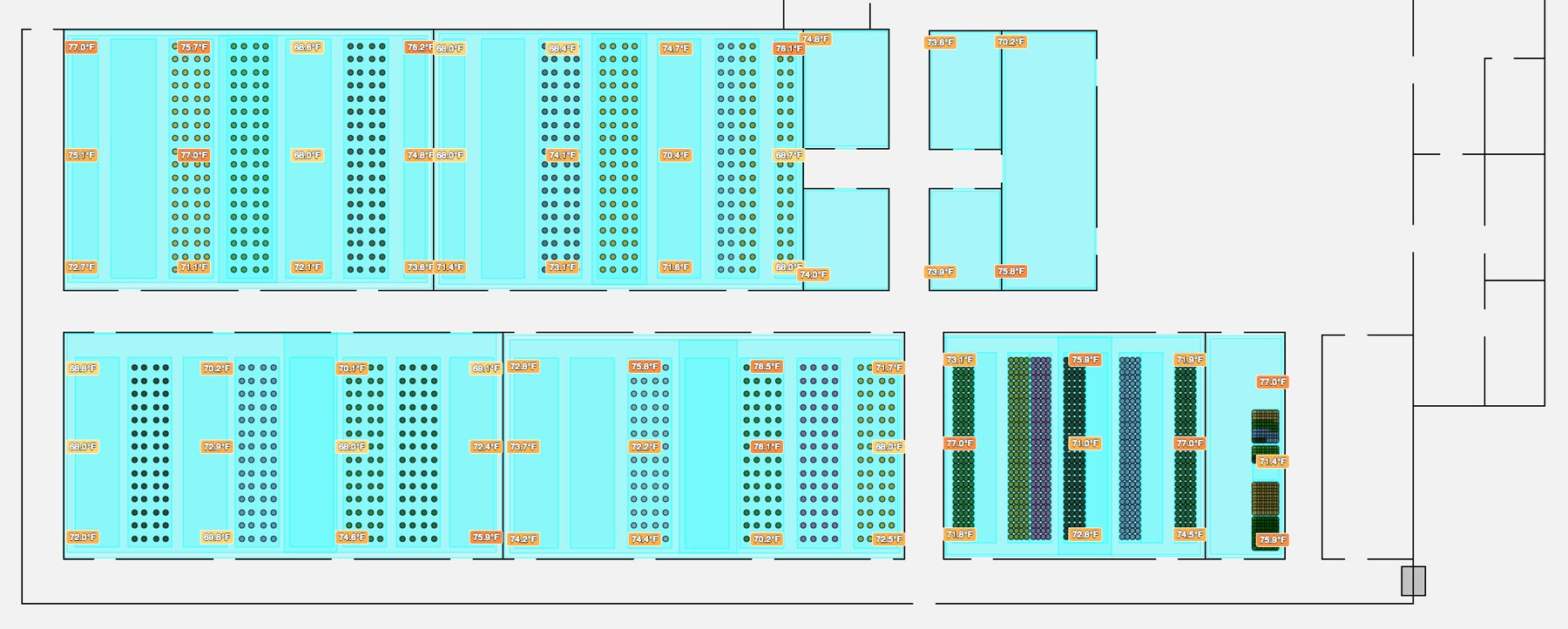
A wall thermostat is one pixel in the wrong place.
It sits on a wall, measuring temperature somewhere in the room, feeding a number into a control loop. The equipment does what it's designed to do. The dashboard shows an average that looks acceptable, and everyone moves on.
But the average is a lie, and that lie is the ceiling on your yield. For most commercial rooms, that ceiling is sitting 20 percent or more below what the facility could actually produce, and nobody can see where the loss is happening.
Most operators assume the binding constraint in commercial cultivation is equipment, genetics, nutrients, or grower experience. Usually it isn't. The binding constraint is the resolution at which the grower can actually see the room. Every other lever (lighting, irrigation, airflow, substrate, cultivar choice) has to pass through the grower's observation of what the crop is experiencing before it converts into yield. When that observation is a single room average, every decision built on top of it is being applied to a crop that doesn't exist. You cannot optimize a distribution you cannot see.
This is the argument behind CropVision and behind the way Grownetics was built. It's also the argument most facilities haven't internalized yet, partly because the cost of not internalizing it is invisible by definition.
The average isn't a summary. It's a blind spot.
Most commercial rooms are still run like one pixel. A thermostat on a wall, a few scattered sensors, a dashboard that rolls them into a single trend line. The average sits comfortably inside its setpoint and the room looks controlled.
Meanwhile, a hot-wet corner at the back has been quietly driving disease pressure for two cycles. A single AC head is underperforming and producing a dead zone in one quadrant. Canopy temperature at mid-height is running warmer than the wall reading because the wall isn't where the plants are. None of that shows up in the average, because none of it can.
The danger isn't that operators lack information. It's that they have information that feels complete. A schedule can't see the thirty-minute irrigation delay that left one bench dry. A twice-daily clipboard check won't catch the two-hour temperature spike before lights-on. The room average said everything was fine; the crop experienced something else. That gap, between what the control system reports and what the plant actually lived through, is where yield goes, and it stays invisible until you have the resolution to see it.
Most growers already feel these microclimates. They know something's off in that corner. What they don't have is the data to prove it, trace it, or act on it with confidence. That's a resolution problem.
What resolution actually means
Resolution is how much detail an operator has about variation in the environment the plant is actually living in, both across space and across time.
Both dimensions matter, and getting one without the other still leaves you blind. Spatial resolution is the where: gradients from floor to canopy, from one zone to the next, from the wall nearest the AC to the corner farthest from airflow. Temporal resolution is the when and how often: once a day on a clipboard, every fifteen minutes from a data logger, or continuously at the minute level. Most facilities are weak on both, and that isn't neutral. Poor resolution doesn't leave you without information. It leaves you with wrong information, delivered with enough confidence to look like control.
More sensors isn't the answer either. We've watched facilities throw a lot of hardware at the problem and still produce unusable data. One greenhouse vendor tried to copy the approach by adding sensor count without any spatial context or placement logic, and ended up with a random average rather than an intelligent map. The quantity of sensors isn't the point; meaningful visibility is.
One canopy sensor, placed at the right height in the right location and logging at the minute, is worth more than six wall sensors averaging every fifteen minutes. Intelligent placement shows you the horizontal and vertical gradients that decide whether your setpoints are actually reaching the crop. Minute-level monitoring catches transient events (control-system hiccups, equipment drift, irrigation timing mismatches) before they become crop events. That's a fundamentally different operating model than scheduled checks against room averages.
Resolution as ceiling, not diagnostic
It's tempting to describe high-resolution sensing as a diagnostic tool, something that helps you find problems faster. That's true as far as it goes, but it understates what's happening. Resolution doesn't only reveal problems. It sets the upper bound on what every other investment in the facility can return.
Think about what happens when a facility upgrades its nutrient program, installs better HVAC, or switches to a higher-performing cultivar. Each of those has a theoretical return. That return only shows up to the extent the intervention lands evenly on the crop. If half the canopy is sitting in a VPD regime the grower doesn't know exists, the nutrient program is being tuned for a plant that isn't there. The HVAC upgrade pulls the average closer to setpoint, but the worst corners, still invisible, keep dragging the ceiling back down. The new cultivar performs to its genetic potential only in the zones where conditions actually match what it needs, and the grower has no way of knowing which zones those are.
Every upgrade is being averaged against a distribution the operator can't see.
This is why resolution sits upstream of almost every other improvement. The question isn't whether better genetics or better equipment will help. They will. The question is how much of that theoretical gain actually reaches harvest, and that conversion rate is capped by visibility. Low-resolution facilities aren't just missing problems. They're throttling the ROI of every other dollar they spend.
When operators do close the gap between intended control and validated canopy reality, the findings are usually more specific than expected. A hot-wet corner that's been driving disease pressure turns out to be a fan placement issue, fixable in an afternoon. A malfunctioning AC head gets caught by coil temperature drift weeks before any crop symptom would have appeared. A greenhouse hotspot that only shows up for two weeks a year, caused by a specific sun angle and a particular roof reflection, gets mapped in one season and solved with targeted shade curtain deployment. Before the mapping, it looked like a random bad run.
The word that matters there is provable. Growers who already suspect these things need something they can bring to ownership, something that ties a quality issue to a specific location, window, or piece of equipment. Resolution is what makes that case legible.
The math
The size of the gap is usually bigger than operators expect, and it's easy to put numbers on it.
A typical commercial room has 20 to 30 percent yield variation across a single zone before any microclimate work gets done. That variation isn't a function of the plants or the genetics. It's a function of what the room is doing to them that nobody can see. Once you can actually see the gradients and fix them, closing a 20 percent gap across the whole room is a realistic target, not a stretch goal.
Run the math on a 1,000 square foot canopy. At 50 grams per square foot across five harvests a year, the room produces 250,000 grams annually, or roughly 550 pounds. A 20 percent lift takes it to 60 grams per square foot, or 300,000 grams, about 660 pounds. That extra 110 pounds, at an average $1,000 per pound wholesale, is $110,000 in additional revenue every year on a single room.
The sensor investment that produces the map behind those fixes is under $1,000.
That's a return profile most operations don't see on any other capital line, and it compounds. The diagnostic work from the first cycle doesn't get undone. It changes how the room runs every cycle afterward, and it makes every subsequent investment, genetics, nutrients, equipment, return closer to its theoretical maximum because the crop is finally being treated as the non-uniform thing it actually is.
These numbers are conservative. A 50 gram per square foot baseline is already a reasonably competent operation; rooms running at 30 or 40 are sitting on more headroom, not less. And in markets where wholesale pricing runs above $1,000 a pound, the revenue delta scales with it.
What changes once the ceiling lifts
Once operators have real visibility, the work itself changes.
Diagnosis gets specific. Instead of "the room is underperforming," you can distinguish a spatial problem, a zone or a corner, from a temporal one, a phase or a window, and that distinction decides whether the fix is equipment, design, or protocol.
Validation becomes routine rather than aspirational. The fact that a setpoint exists isn't evidence it was achieved, and the fact that an irrigation event fired isn't evidence the emitters actually delivered to every zone. Control systems fail, and they need a crop-analytics layer above them because the failures are only visible when someone is watching at the right resolution.
Maintenance becomes predictive. Coil temperature drift, CO2 sensor drift, pump performance variation all produce detectable signals well before they produce crop symptoms. Waiting for a visible symptom is waiting for a loss event.
Facility design becomes something you can actually improve. The data from a high-resolution commissioning phase is often the single most valuable dataset a facility ever generates, because it shows where the real gradients are, where the design assumptions were wrong, and where targeted changes will have the most leverage. Many operations run heavy instrumentation at startup and taper to lighter long-term monitoring afterward, which is a reasonable approach, but only if the startup phase produced the diagnostic map in the first place.
And steering becomes real. Environmental steering based on room averages is aspiration dressed up as strategy. Steering based on what the canopy and root zone actually experienced is a different discipline, and it's only available to operators with the resolution to support it.
Floor and ceiling
One honest caveat, reframed.
Resolution isn't a substitute for operational fundamentals. If process discipline is inconsistent, water treatment and fertigation are unreliable, or the substrate program is mismatched to the cultivar, more resolution won't fix any of it. What it will do is make those problems more visible, which is valuable, but visibility without controllability produces overload rather than clarity.
The better way to think about this is floor and ceiling. Fundamentals are the floor, the baseline operational reliability below which nothing else works. Resolution is the ceiling, the upper bound on what the room can deliver once the floor is stable. They aren't competing priorities or sequential phases. They define the room together. A facility with a strong floor and a low ceiling produces consistent mediocrity. A facility chasing a high ceiling over a broken floor produces expensive chaos. The operations that pull ahead are the ones that understand both, and that recognize the ceiling is where the remaining yield actually lives.
Most systems summarize the room. The opportunity is in the differences inside it.
The operational question
Here's the practical test. Can you currently trace a yield constraint, a quality issue, or a recurring disease event to a specific location, time window, or piece of equipment behavior in your facility? Can you prove it with data, not just suspect it?
If the answer is no, or mostly but not with confidence, the ceiling is lower than it needs to be, and the room is leaving meaningful revenue on the table every harvest. Every other investment in the operation is returning less than it could, and the gap between what the room is producing and what it's capable of isn't a mystery that more intuition will solve. It's a measurement problem, and it has a measurement solution.
The room is more complex than the average suggests. That complexity isn't noise. It's where the opportunity lives.
A lack of precision is no control at all.