Maximizing Crop Yields: The Key Role of Microclimate Mapping in Cannabis Cultivation
Why environmental uniformity matters more than room averages, and how microclimate mapping reveals the conditions plants actually experience.
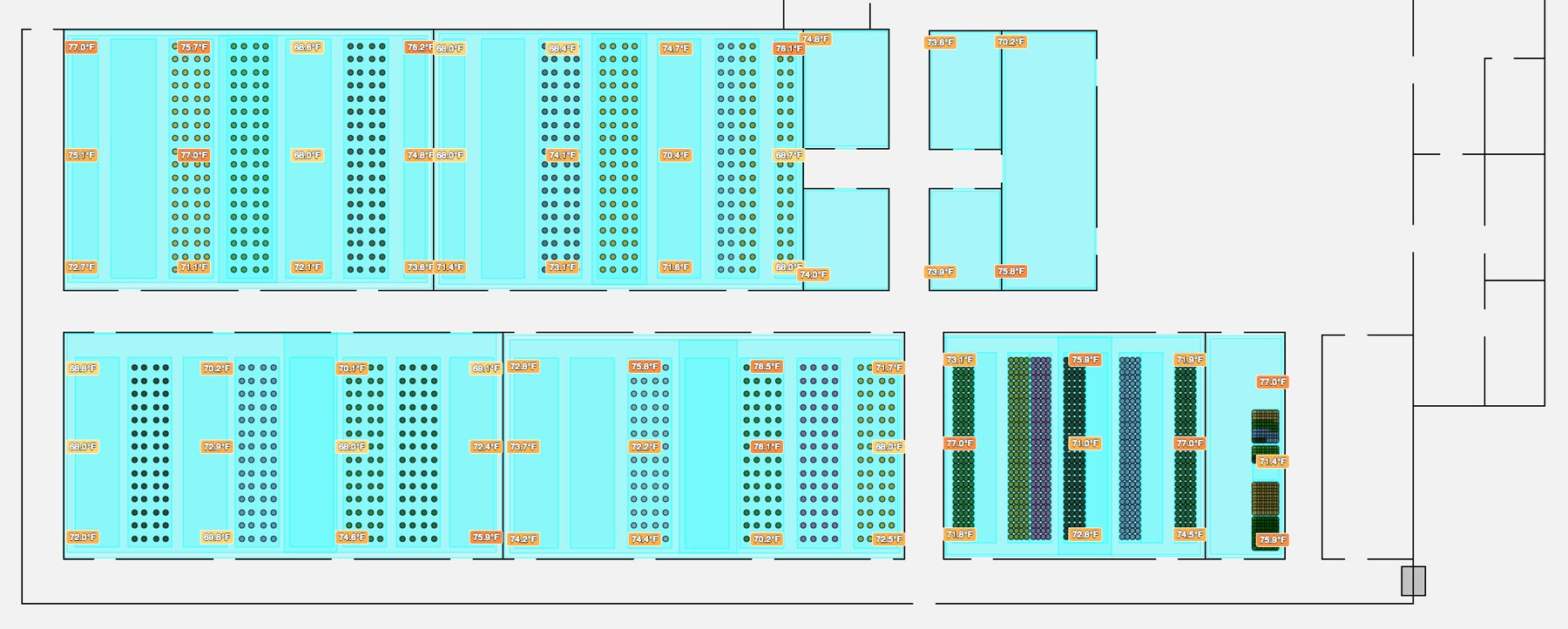
In commercial cannabis cultivation, microclimate mapping plays a fundamental role in optimizing plant growth. The practice involves measuring how environmental conditions like temperature, humidity, and light intensity vary across different positions within a growing facility, rather than relying on a single average reading.
The Importance of Environmental Uniformity
A homogeneous growing environment is essential for maintaining consistent VPD (vapor pressure deficit), which directly influences transpiration rates, water and nutrient uptake, and overall plant health. This becomes increasingly complex in vertical growing systems, where microclimates vary between tiers. Plants do not experience the room average. They experience the local environment around them.
VPD and Plant Health
VPD represents the difference between actual moisture in the air and the air's maximum moisture capacity when saturated. Optimal VPD enables effective transpiration, the process by which plants release water vapor. When VPD falls too low, mold and fungal diseases become likely. Conversely, excessively high VPD stresses plants, causing stunted growth or wilting.
HVAC Design Implications
Research has shown that room-as-plenum HVAC designs create inconsistent air speed and temperature distribution, leading to uneven growth. Direct canopy environment control systems deliver pre-conditioned air more effectively to plants.
Transpiration and Nutrient Distribution
Consistent transpiration supports nutrient movement from roots to leaves, enabling efficient photosynthesis and compound development that contributes to cannabis quality and potency. Inconsistent transpiration causes nutrient imbalances and plant stress.
Technology Solutions
Advanced visualization tools like Grownetics CropVision Software provide 2D and 3D environmental mapping, allowing growers to identify and adjust variances across every tier and zone. Wireless microclimate sensors with two-mile range and battery life exceeding two years enable comprehensive monitoring without installation constraints.
Practical Benefits
Better environmental visibility helps growers detect problem areas like hot zones, cold spots, humidity pockets, and airflow issues before they result in yield loss or quality inconsistency. This precision control is essential for maximizing vertical space utilization and maintaining crop uniformity across large-scale operations.